
Monsoon Sale! Let Confidence Rain with 6% Off. Code: MONSOON6

7 Resume Mistakes That Are Silently Killing Your Chances
75% of resumes fail ATS scans. Learn the 7 resume mistakes silently ruining your chances and how to fix them for recruiter approval and job success.
InterviewBuddy - 18 Aug 2025
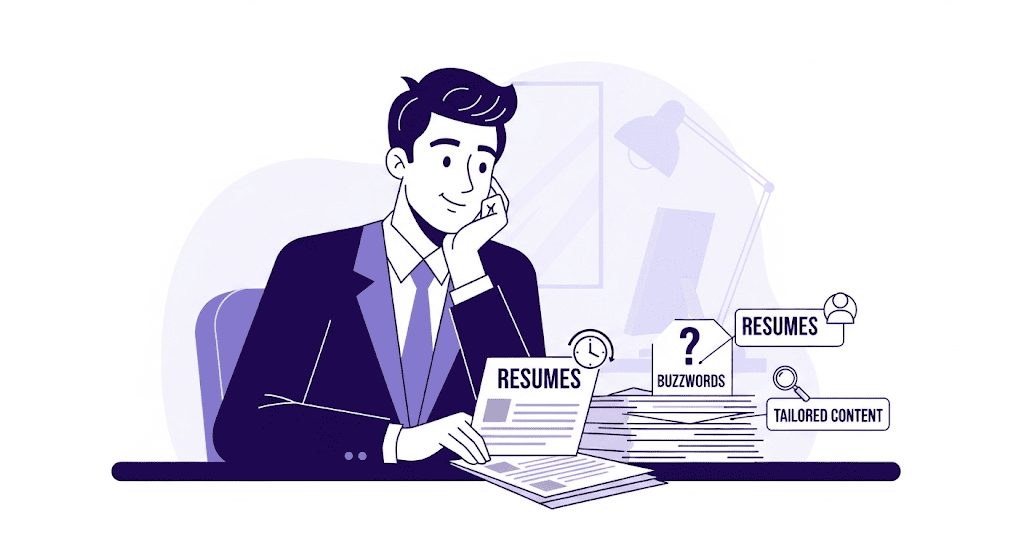
Recruiters skim resumes for 6 to 8 seconds. If you make one of these mistakes, you're instantly in the "no" pile, no matter how qualified you are.
Let’s break it down, mistake by mistake.
1. Starting with an Objective Statement
Objective statements are outdated and usually say something vague like:
“To obtain a challenging role in a dynamic organization where I can grow and contribute.”
The problem? It talks about what you want, not what you offer. Start with a summary that proves your worth - what value you bring to the table.
“Data analyst with 2+ years in SaaS, optimized churn rate by 18% using predictive analytics. Skilled in SQL, Tableau, and Python.”
Your introduction should not be a wish, but rather a pitch.
2. Describing your job role, not achievements
Imagine this on two resumes:
- “Managed social media accounts.”
- “Grew Instagram following from 4K to 22K in 6 months via reels and collaborations.
Employers hire for results. So it is best to mention the actual growth and achievements you have driven in your past working experiences.
3. Using Buzzwords Without Proof
Words like “hardworking,” “team player,” “go-getter” = fluff.
Without evidence to support them, they do nothing to strengthen your resume.
Buzzword-only example:
“Highly motivated team player with strong communication skills.”
This could describe thousands of people. It's vague.
Try this:
Team player: “Collaborated with 4 departments to streamline onboarding”
Results-driven: “Launched campaign that generated 1.5x ROI in 8 weeks”
4. Writing in Huge Walls of Text
Blocks of text are hard to scan, and recruiters are busy. A paragraph summary of each job is visually dense and likely to be skipped.
- Use bullet points for each job under “Experience”
- Keep bullets to 1–2 lines max
- Highlight 3–5 strong points per role (fewer if recent grads)
For example:
- Wrote 10+ SEO blogs (avg. 1.2K views)
- Built and tracked 5 email campaigns (22% open rate)
5. Including Irrelevant Experience or Hobbies
You don’t need to list every job you’ve ever had, especially if it's unrelated or too far in the past.
Common mistakes include:
- Including part-time jobs from 8 years ago
- Listing hobbies like "watching Netflix" or "hanging out with friends" - These are not hobbies
- Keeping “References available on request”
Focus on the last 5–10 years of relevant experience. Leave out jobs unless they demonstrate transferable skills or leadership.
Only include hobbies if they reflect initiative or unique strengths (e.g., building an app, running a blog, leading a volunteer team) Recruiters want a focused, relevant picture, not your entire life story.
6. Overdesigning Your Resume
Many companies use Applicant Tracking Systems (ATS) to scan resumes before a human even sees them.
Over-designed resumes with graphics, icons, sidebars, and non-standard fonts often break during this scan.
Design Elements That Break ATS:
- Two-column layout - Confuses text hierarchy
- Icons & logos - Often unreadable
- Profile photo - Can introduce unnecessary bias
- Graph-based skill ratings - Not interpretable by software
Instead, use a clean, single-column layout, stick to professional fonts (Arial, Calibri, Times New Roman), the recommended font size is between 12 to 14, and keep formatting minimal.
Design should support your content, not overpower it.
InterviewBuddy offers professional resume writing services tailored for different roles and industries.
Whether you’re a student or mid-career pro, their experts help create resumes that pass ATS filters and get recruiter attention.
7. Submitting the Same Resume to Every Job
Recruiters (and ATS bots) look for specific skills, tools, and language from the job description. If your resume doesn’t reflect those, you’ll seem like a weak match.
Use the following tips:
- Tailor the skills, keywords, and accomplishments to each job.
- Use keywords from the JD.
- Reorder bullets to match the job’s priorities.
The strongest resumes are clear, relevant, and tailored. They:
- Communicate value fast
- Align with each specific role
- Avoid clutter, fluff, and unnecessary design
And most importantly, they don’t leave anything up to chance.
If you’re not sure whether your resume is helping or hurting you, it’s worth getting a second opinion or professional support.
Whether it's formatting, keyword optimization, or rewriting from scratch** InterviewBuddy’s resume writing service** can help you build a resume that opens doors.
Recent blog posts
Tue, 09 Jun 2026
7 Answers That Instantly Kill Your Chances
💡 The biggest interview killer isn’t lack of talent - it’s lack of awareness in your answers. They fail because of one careless sentence - a response that instantly signals immaturity, defensiveness or lack of self‑awareness. The worst part? These mistakes are predictable and avoidable. In this article, I break down 7 common interview answers that quietly sabotage your chances, explain why they send the wrong signal and show you how to reframe them into credibility‑building responses. 👉 If you’ve ever wondered why interviews slip away despite solid preparation, this is the guide you need before your next one.
Thu, 05 Mar 2026
I’ve Seen 1,000+ Interviews. These Answers Kill Your Chances (and What To Say Instead)
Let me be honest with you interviews don’t fall apart because candidates say something stupid. They fall apart because candidates say something normal.
Thu, 05 Mar 2026
Tiny Habits Win Interviews More Than Your Resume
Resumes get you shortlisted. Tiny habits decide whether you get selected.





of U&U Connoisseurs (I) Private Limited
Quick Links
Free illustrations from Streamline
 +91 8500 99 0101